It’s March 2026. The April 15 deadline for your 2025 taxes looms just weeks away. You might feel overwhelmed if this is your first time. Don’t worry. Filing taxes is simpler than it looks, especially with free IRS tools and straightforward steps.
This guide walks you through everything from checking if you must file to claiming your refund. You’ll learn federal and state basics, plus recent updates like higher standard deductions. Follow along, and you’ll snag refunds or credits that put cash back in your pocket. Let’s get started.
Step 1: Check If You Need to File and Mark Your Deadlines
First, figure out if you must file a return for 2025. You need to file if your gross income hits these thresholds. For singles under 65, it’s $15,750. Married filing jointly under 65? That’s $31,500. Head of household under 65 faces $23,625.
Age matters too. If you’re 65 or older, add extras: $2,000 for singles or head of household, $1,600 per spouse for joint filers. Self-employed folks file if net earnings top $400. Even if you don’t have to file, do it anyway. You could get back withheld taxes as a refund.
Most states require returns if you owe federal taxes. Mark these 2026 deadlines now:
- W-2s and key 1099s arrive by February 2.
- File and pay by April 15.
- Request extension with Form 4868 by April 15 (filing moves to October 15, but pay what you owe first).

Circle them on your calendar. Missing April 15 triggers penalties. Extensions buy time, but payments don’t wait.
Quick Tool to Confirm Your Filing Need
The IRS offers a free interactive tool. Answer simple questions about your income and status. It tells you right away if you need to file.
Head to the IRS Do I Need to File a Tax Return tool. Dependents face lower limits, like $17,750 earned income. Use it today. It takes minutes and clears confusion.
Step 2: Gather Your Tax Documents Without Missing a Thing
Collect papers early. This step prevents headaches later. Start a folder on your desk or phone app. Keep records three years, as the IRS might ask.
Here’s your checklist:
- Personal info: Social Security number, spouse details if joint, dependents’ SSNs, IDs.
- Income docs: W-2 for wages, 1099-NEC for freelance gigs, 1099-K for payments over $600, 1099-R for pensions, SSA-1099 for Social Security, 1099-INT/DIV for interest or dividends. Track crypto basis yourself; new 1099-DA reports sales.
- Other items: HSA/IRA forms, estimated tax payments, business expenses, last year’s return, IRS letters.
Employers send W-2s by February 2. Check mail, email, or portals. Gig apps like Uber send 1099s too. Scan everything digitally. If missing a form, contact the sender fast.
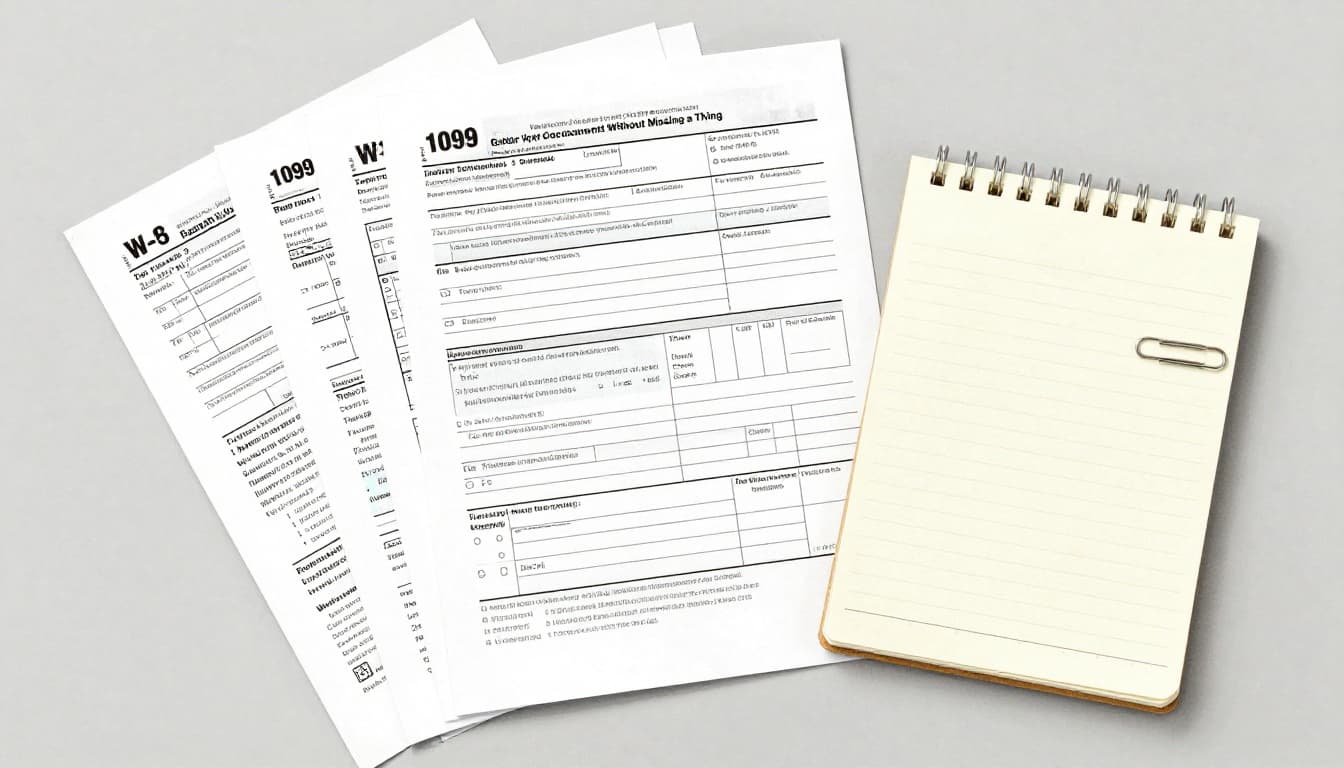
Organize like this image shows. Neat stacks make entry easy. Double-check for errors on forms. Now you’re set.
Step 3: Pick Your Filing Status and Choose How to Submit
Your filing status sets deductions and tax rates. Pick the right one. Single works if unmarried without dependents. Married filing jointly often saves money; it doubles the standard deduction.
Head of household fits if you support a qualifying child or relative. Qualifying surviving spouse applies to recent widows with kids. Check if someone claims you as a dependent; that changes everything.
Next, decide how to file. E-file tops the list for beginners. It’s fast, secure, and refunds hit in 21 days. Use IRS Free File if your 2025 AGI is $89,000 or less. It covers federal and many states.
Options include:
- Free File Guided Tax: Software walks you through, all 50 states plus D.C.
- Free File Fillable Forms: Basic electronic forms, no income limit.
- Paid software like TurboTax handles complex cases.
- Paper forms go by mail, but they’re slow and error-prone.
Start at IRS Free File page. Pick a partner. E-file checks math automatically.
Why E-File Is a First-Timer’s Best Friend
E-file catches mistakes before submission. Free options fit most budgets. Services like H&R Block or Jackson Hewitt offer in-person help if needed. Refunds direct-deposit in weeks. Paper? Expect months. Go digital for peace.
Step 4: Build Your Return on Form 1040 with Deductions and Credits
Grab Form 1040 (or 1040-SR if 65+). Report all income first. Subtract deductions for taxable income. Calculate tax owed, then subtract credits.
Use Schedules 1 for extra income or adjustments, Schedule 3 for credits. Standard deduction is simplest: $15,750 single under 65, up to $34,700 joint both 65+. Itemize if higher; think medical bills over 7.5% AGI, charity, state taxes (capped rising 1% yearly), mortgage interest.
Credits beat deductions. They cut taxes dollar-for-dollar. Earned Income Tax Credit helps low-income workers with kids. Child Tax Credit gives up to $2,000 per child.
Example: Single filer earns $40,000. Standard deduction leaves $24,250 taxable. Tax might be $2,500. EITC or education credits wipe that out, even refund extra.
Download 2025 Form 1040 instructions for details. Software fills it automatically.
Picture yourself here, pencil ready. Take it slow.
Top Deductions and Credits First-Timers Often Miss
Many skip these. Compare standard vs. itemized; pick the bigger. EITC needs earned income under limits, kids optional. Child Tax Credit phases out at higher incomes. American Opportunity Credit refunds education costs up to $1,000.
Check eligibility. They mean real money back.
Step 5: Add State Taxes, Avoid Mistakes, and Hit Submit
Forty-one states tax income. Deadlines match federal. E-file state returns free with many federal tools. Deduct state taxes on federal if itemizing.
New rules: Crypto gets 1099-DA. W-2s due February 2. Skip these mistakes:
- Miss deadline (5% monthly penalty).
- Wrong status or forget dependents.
- Omit 1099 gig income.
- Skip self-employment payments.
E-file avoids paper errors. Save copies. Call IRS at 800-829-1040 if stuck. Submit, then track your refund at the IRS Where’s My Refund tool. Expect 21 days for e-file.
Nine states skip income tax: Alaska, Florida, Nevada, New Hampshire, South Dakota, Tennessee, Texas, Washington, Wyoming.

Watch that progress bar fill. You’re almost done.
Your State Tax Quickstart
Visit your state revenue site. Free e-file often matches federal. No-income-tax states still want sales or property filings sometimes.
Ready to Nail Your First Tax Filing
You now know the five steps: check need and dates, gather docs, pick status and method, build the return, submit with states. Great job starting.
Free IRS help waits at VITA sites for low-income filers. File soon for that refund. Grab docs today. Bookmark IRS.gov. Peace of mind follows. You’ve got this.