
Imagine Sarah. She earns the same salary each year. Last tax season, she claimed deductions she overlooked before. Her tax bill dropped by $2,000. No income change. Just smarter choices.
Tax deductions lower the income you pay taxes on. They don’t touch your tax rate. You subtract them from gross income first. This shrinks your taxable amount. Many folks save hundreds or thousands without effort.
You wonder how this works in practice? This post breaks it down. We cover the basics, types like above-the-line and standard versus itemized, 2025 amounts, common examples, fresh changes, credits comparison, claiming steps, and pitfalls. For the 2025 tax year, savings add up fast. Let’s get started.
How Tax Deductions Lower Your Taxes Step by Step
Tax deductions reduce your taxes in a clear sequence. Start with total income. Subtract above-the-line deductions. That gives adjusted gross income, or AGI. Then subtract standard or itemized deductions. You reach taxable income. The IRS taxes only that final number.
Take this example. You earn $80,000. Claim $5,000 in above-the-line deductions, like student loan interest. AGI drops to $75,000. Pick the $15,000 standard deduction for singles. Taxable income lands at $60,000. You pay taxes on less. Simple math saves real money.
About 90% of people choose standard deductions. They offer ease. Yet always pick the larger option between standard and itemized. That maximizes savings. Here’s a visual of the process.
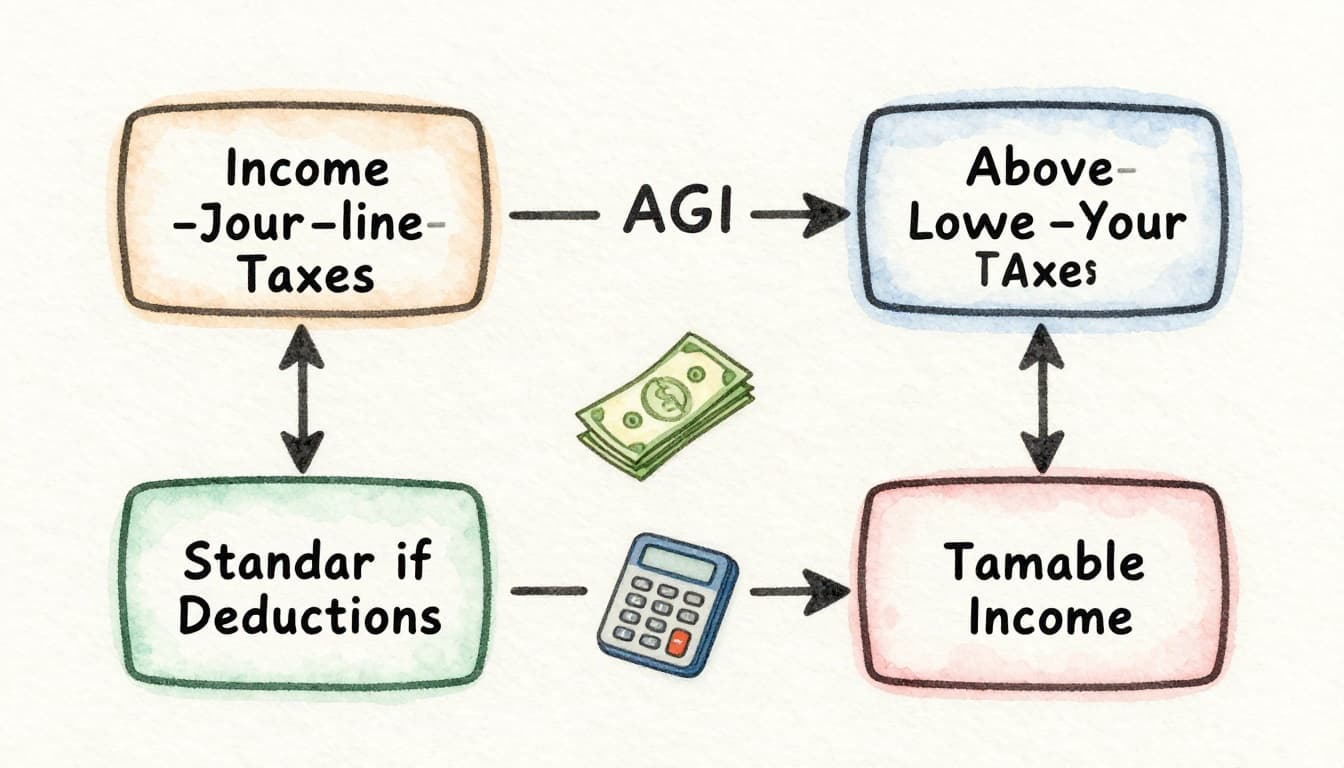
- List gross income from wages and investments.
- Subtract above-the-line items. Get AGI.
- Subtract standard or itemized. Reach taxable income.
- Apply tax rates to that amount.
In short, each step cuts what Uncle Sam taxes.
Above-the-Line Deductions: Claim These No Matter What
These deductions come first. They lower AGI before other choices. You claim them even if you take the standard deduction. No need to itemize.
Top examples include student loan interest up to $2,500. IRA or 401(k) contributions count too. Health savings account payments qualify. Self-employed folks deduct business costs. Teachers claim up to $300 for classroom supplies.
Picture a teacher like Mike. He spends $250 on books and glue. That subtracts from his AGI right away. His taxes drop. Everyone can use these. Check TurboTax’s guide on above-the-line deductions for more examples.
Besides, they open doors to credits. Lower AGI helps you qualify. Track these early.
Standard vs Itemized: Choose the One That Wins for Your Situation
Standard deductions offer a fixed amount. Easy and quick. Itemized list actual expenses. Pick whichever beats the other.
You calculate after above-the-line. Compare totals. Software makes it simple. Itemize only if expenses top standard. Rare cases require itemizing, like some casualty losses.
Here’s a quick pros and cons table:
| Type | Pros | Cons |
|---|---|---|
| Standard | Fast; no receipts needed | Fixed; may miss big expenses |
| Itemized | Tailored to your spending | Time-consuming; proof required |
Most stick with standard. Test both. Tools like those on IRS credits and deductions page help compare.
Your 2025 Standard Deduction: Exact Amounts and Bonus Perks
For 2025 taxes, standard deductions rose with inflation. Amounts match your filing status. Seniors get extras.
Base figures:
Single or married filing separately: $15,750.
Married filing jointly or qualifying surviving spouse: $31,500.
Head of household: $23,625.
Add for age 65 or older (or blind): $2,000 if single or head of household. $1,600 per qualifying spouse if married filing jointly.
New senior bonus through 2028: $6,000 extra for single or head of household (phases out above $75,000 MAGI). $12,000 if both spouses qualify on joint returns (phases out above $150,000 MAGI).
Everyday couples often review these at home. See this scene.

Full table for quick scan:
| Filing Status | Base | 65+ (per person) | Senior Bonus (if qualify) |
|---|---|---|---|
| Single/HOH | $15,750/$23,625 | +$2,000 | +$6,000 |
| MFJ (both 65+) | $31,500 | +$1,600 x2 | +$12,000 |
Itemizing beats standard with large mortgages or medical bills. Confirm your status first.
Details appear in IRS courseware on standard deductions.
Top Itemized Deductions Plus Exciting 2025 Updates
Itemized deductions suit high spenders in certain areas. Common ones: mortgage interest on up to $750,000 debt. State and local taxes (SALT) now cap at $40,000 for joint filers, up from $10,000. It grows 1% yearly through 2029.
Charity donations count fully if cash. Medical expenses over 7.5% of AGI qualify. Disaster losses too. Home office for employees? Check rules.
New for 2025: Car loan interest up to $10,000 on new U.S.-assembled vehicles. Tip income deduction reaches $25,000 if reported (phases out over $150,000 single AGI). Learn about NPR’s take on car loan deductions.
Donations make a difference. Consider this example.

Keep receipts. These add up fast.
Deductions vs Tax Credits: Get This Right for Maximum Savings
Deductions shrink taxable income. A $1,000 deduction saves $100 to $370, based on your bracket.
Credits cut tax owed directly. Dollar for dollar. The 2025 Child Tax Credit offers $2,200 per child under 17. Up to $1,700 refundable.
Example: $1,000 deduction in 22% bracket saves $220. Same credit saves $1,000 full.
Credits beat deductions often. Yet deductions apply broader. Use both.
Claim Your Deductions Easily and Dodge Common Traps
Gather records first. List above-the-line on Form 1040. Tally itemized on Schedule A if needed. Compare to standard. Choose larger. File.
Software speeds this. Handles math and checks.
Organize papers like this.

Pitfalls That Cost You Money and How to Avoid Them
Forget above-the-line. Many skip them on standard returns. Claim anyway.
No receipts? Audits hurt. Scan and store digitally.
Wrong status? Switch to head of household if you qualify. Saves more.
Miss limits? New deductions phase out. Check income.
Double-dip standard and itemized. Pick one only.
Personal costs as business? No. Keep separate.
A friend lost $500 forgetting educator supplies. Review everything.
Smart Moves Pay Off with Tax Deductions
Grasp the types: above-the-line first, then standard or itemized. For 2025, grab higher standard amounts or itemize if bigger. Watch SALT hikes and new perks like car loans.
Review your 2025 finances now. Use IRS.gov tools or software. Share this if it helps. Got questions? Comment below. Talk to a pro for tricks.
Deductions return cash to you. Act soon.